NAD+ 1,500mg LIQUID SPRAY
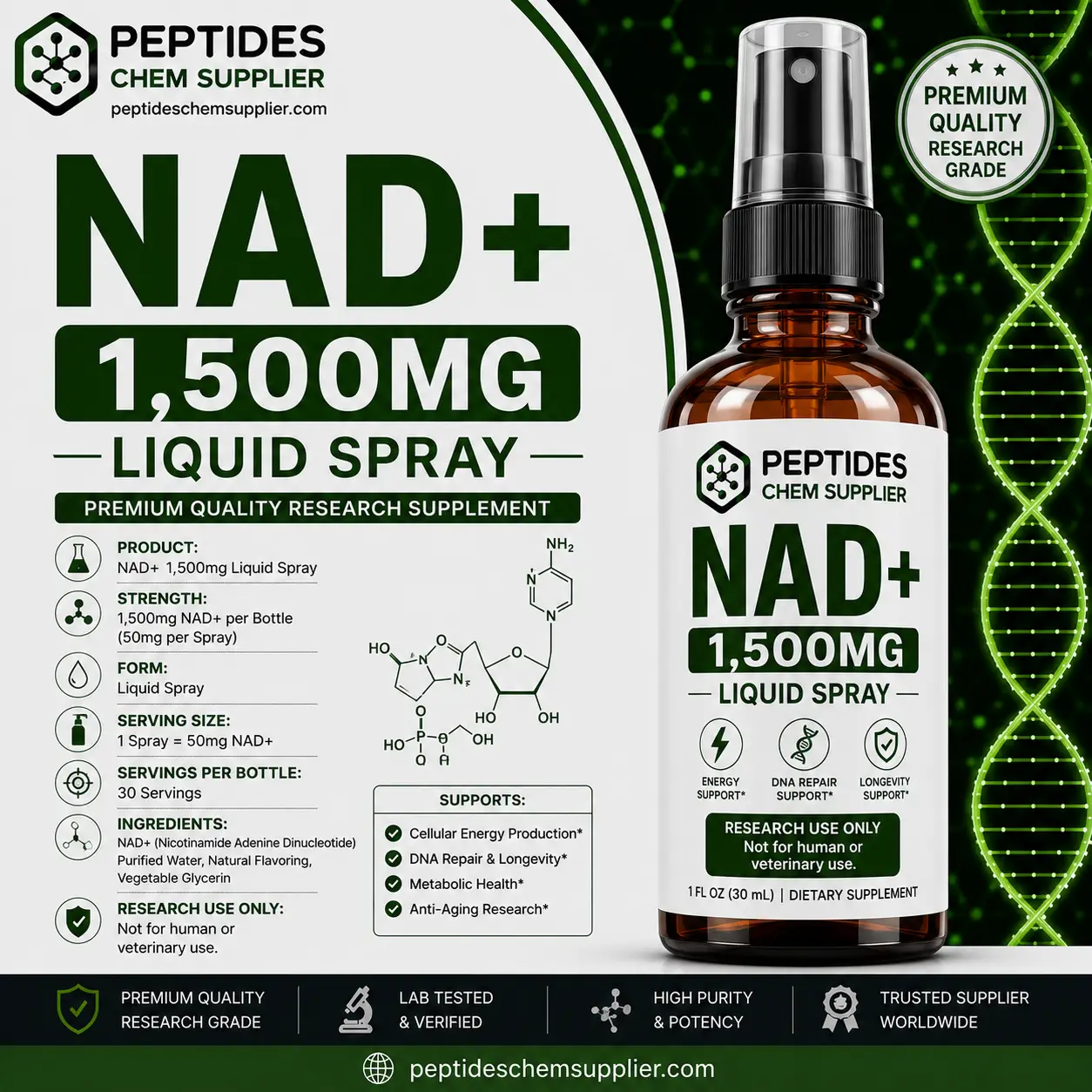
Product Name: NAD+ 1,500mg Liquid Spray
Compound: Nicotinamide Adenine Dinucleotide
Abbreviation: NAD+
Quantity: 1,500mg
Product Category: Research material
Compound Type: Dinucleotide coenzyme
Physical Form: Liquid spray
Research Areas: Biochemistry, cellular metabolism, redox biology, mitochondrial research, molecular biology, and enzyme research
Intended Application: Laboratory and analytical research
Concentration: Refer to current product specifications
Documentation: Batch-specific documentation where available
Purity: Refer to the applicable Certificate of Analysis
Storage: Follow product-specific documentation
Use: Research use only
$109.50
NAD+ 1,500mg Liquid Spray Research Material
NAD+ 1,500mg Liquid Spray is a research-oriented formulation containing nicotinamide adenine dinucleotide (NAD+), supplied for qualified laboratory, analytical, educational, and scientific research applications. NAD+ is a naturally occurring coenzyme involved in numerous biochemical processes, including redox reactions, cellular metabolism, mitochondrial function, DNA-related processes, and enzyme activity.
The liquid spray format provides a formulated presentation of NAD+ for research applications. Researchers should verify the actual concentration, formulation, solvent or vehicle, stability, and batch-specific analytical information before incorporating the material into an experimental workflow.
For Research Use Only. Not for Human Consumption.
NAD+ 1,500mg Product Information
Product Name: NAD+ 1,500mg Liquid Spray
Compound: Nicotinamide Adenine Dinucleotide
Abbreviation: NAD+
Quantity: 1,500mg
Product Category: Research material
Compound Type: Dinucleotide coenzyme
Physical Form: Liquid spray
Research Areas: Biochemistry, cellular metabolism, redox biology, mitochondrial research, molecular biology, and enzyme research
Intended Application: Laboratory and analytical research
Concentration: Refer to current product specifications
Documentation: Batch-specific documentation where available
Purity: Refer to the applicable Certificate of Analysis
Storage: Follow product-specific documentation
Use: Research use only
Researchers should confirm the exact concentration and formulation of the liquid spray through the applicable product documentation.
What Is NAD+?
Nicotinamide adenine dinucleotide (NAD+) is an important coenzyme found throughout biological systems. NAD+ participates in oxidation-reduction reactions by accepting electrons and becoming NADH, while NADH can subsequently be converted back to NAD+.
This reversible NAD+/NADH system makes NAD+ particularly important in research involving cellular energy production and redox metabolism.
Research areas associated with NAD+ include:
- Cellular respiration
- Energy metabolism
- Mitochondrial biology
- Redox reactions
- Enzyme activity
- Metabolic signaling
- DNA-related processes
- Cellular stress responses
- Molecular biology
NAD+ and Cellular Metabolism Research
NAD+ participates in numerous metabolic pathways and functions as a cofactor in oxidation-reduction reactions.
Researchers may examine NAD+ in relation to:
- Glycolysis
- Citric acid cycle
- Oxidative phosphorylation
- Cellular respiration
- Electron transfer
- ATP-associated metabolism
- Metabolic regulation
The NAD+/NADH balance can also be investigated as part of experimental studies examining cellular metabolic states.
NAD+ and Mitochondrial Research
Mitochondria depend on NAD+-associated redox reactions for efficient energy metabolism.
Research involving NAD+ may investigate mitochondrial electron transfer, oxidative metabolism, and relationships between cellular redox balance and mitochondrial activity.
Potential research areas include:
- Mitochondrial respiration
- Electron transport
- Oxidative metabolism
- Cellular energy production
- Redox homeostasis
- Mitochondrial signaling
- Metabolic flexibility
NAD+ therefore represents an important research material for laboratories studying cellular and mitochondrial metabolism.
NAD+ and Redox Biology
The NAD+/NADH system is central to redox biology.
Because NAD+ can participate in reversible electron-transfer reactions, researchers can examine changes in NAD+ and NADH under different experimental conditions.
Research may involve:
- NAD+/NADH ratios
- Electron-transfer reactions
- Redox signaling
- Oxidative metabolism
- Cellular stress
- Metabolic state
- Enzyme activity
Analytical methods can be used to evaluate NAD+ and related metabolites in controlled research systems.
NAD+ and Enzyme Research
NAD+ is involved in the activity of multiple enzyme families.
Researchers may investigate NAD+-dependent enzymes such as:
- Sirtuins
- Poly(ADP-ribose) polymerases
- ADP-ribosyltransferases
- Dehydrogenases
- Other NAD-dependent metabolic enzymes
These enzyme systems are relevant to research involving protein modification, metabolic regulation, cellular signaling, and DNA-related processes.
NAD+ and Sirtuin Research
Sirtuins are NAD+-dependent enzymes that have attracted significant interest in molecular and cellular research.
Researchers may investigate how NAD+ availability relates to sirtuin activity and associated biochemical pathways.
Research areas can include:
- Protein deacetylation
- Enzyme activity
- Metabolic regulation
- Cellular signaling
- Mitochondrial pathways
- Stress-response mechanisms
The relationship between NAD+ metabolism and sirtuin activity continues to be an important area of biochemical research.
NAD+ and DNA-Related Research
NAD+ is also involved in research concerning poly(ADP-ribose) polymerase (PARP) activity.
PARP enzymes use NAD+ during ADP-ribosylation reactions associated with cellular responses to DNA damage.
Researchers may investigate:
- DNA damage responses
- DNA repair pathways
- ADP-ribosylation
- Nuclear signaling
- Cellular stress
- Genome-maintenance mechanisms
This makes NAD+ relevant to molecular biology and cellular-stress research.
NAD+ 1,500mg Liquid Spray Research Applications
Biochemical Research
NAD+ can be evaluated in laboratory experiments involving enzyme activity, metabolic reactions, and biochemical pathways.
Cellular Metabolism
Researchers may investigate NAD+ as part of cellular energy and metabolic pathways.
Mitochondrial Biology
NAD+ is relevant to studies involving mitochondrial respiration and oxidative metabolism.
Redox Research
The NAD+/NADH system provides a useful model for studying oxidation-reduction reactions.
Enzyme Research
NAD+ can function as a cofactor or substrate in appropriate biochemical assays.
Molecular Biology
Researchers may investigate NAD+-dependent pathways involving cellular signaling, DNA-related processes, and protein modification.
NAD+ Liquid Spray Formulation
The liquid spray presentation differs from powdered NAD+ research material in terms of formulation and physical characteristics.
For laboratory research, scientists may evaluate:
- Active NAD+ concentration
- Formulation composition
- Solvent or vehicle
- Homogeneity
- Physical appearance
- Stability
- Container compatibility
- Batch consistency
- Chemical purity
- Degradation products
The exact formulation should always be confirmed through the applicable product documentation.
Researchers should not assume that NAD+ liquid sprays from different suppliers have identical concentrations, solvents, or stability characteristics.
NAD+ 1,500mg Research Material
The 1,500mg quantity represents the total labeled amount of NAD+ research material associated with the product.
Laboratory characterization may include:
- Compound identity
- Chemical purity
- Concentration
- Molecular characterization
- Stability
- Solubility
- Batch consistency
- Analytical profile
- Related impurities
- Degradation products
Researchers should follow product-specific documentation for storage and laboratory handling requirements.
Certificate of Analysis
A Certificate of Analysis (COA) can provide important batch-specific information when evaluating NAD+ 1,500mg Liquid Spray.
Depending on the applicable batch, documentation may include:
- Product identification
- Compound identification
- Batch or lot number
- Reported concentration
- Analytical testing
- Reported purity
- Testing date
- Formulation information
- Applicable specifications
- Laboratory test results
Researchers should review documentation associated with the specific batch being evaluated.
NAD+ Liquid Spray Quality Considerations
When evaluating NAD+ 1,500mg Liquid Spray, laboratories may consider:
- Compound identity
- Chemical form
- Active concentration
- Chemical purity
- Formulation composition
- Solvent or vehicle
- Batch traceability
- Analytical documentation
- Physical appearance
- Stability
- Container compatibility
- Storage requirements
- Testing methodology
- Related impurities
- Applicable regulatory requirements
For liquid research materials, concentration and formulation information are particularly important when comparing products from different sources.
NAD+ Research Material Supplier
Researchers searching for NAD+ liquid research materials may use several related terms, including:
- NAD+ 1,500mg Liquid Spray
- NAD+ 1500mg research material
- NAD+ liquid research material
- NAD+ liquid research compound
- NAD+ research spray
- Nicotinamide adenine dinucleotide research material
- NAD plus liquid research material
- NAD+ biochemical research compound
- NAD+ laboratory research material
- NAD+ metabolic research compound
- NAD+ redox research material
Using both NAD+ and the full chemical name nicotinamide adenine dinucleotide can help researchers locate relevant scientific information.
International NAD+ Research
Researchers in different geographic markets may use location-specific search terms when looking for NAD+ liquid research materials.
Relevant searches can include:
- NAD+ 1500mg liquid research material USA
- NAD+ liquid research compound USA
- NAD+ research spray USA
- NAD+ 1500mg liquid research material UK
- NAD+ liquid research compound UK
- NAD+ research spray UK
- NAD+ 1500mg liquid research material Canada
- NAD+ liquid research compound Canada
- NAD+ research spray Canada
- NAD+ 1500mg liquid research material Europe
- NAD+ liquid research compound Europe
- NAD+ research spray Europe
- NAD+ 1500mg liquid research material Australia
- NAD+ liquid research compound Australia
- NAD+ research spray Australia
- NAD+ 1500mg liquid research material India
- NAD+ liquid research compound India
- NAD+ research spray India
Availability, import requirements, customs rules, and regulatory requirements can differ between jurisdictions. Customers and laboratories are responsible for determining the requirements applicable to research materials in their location.
Geographic terminology is included to help researchers locate relevant research information and does not imply authorization for human use in any particular country.
NAD+ and Scientific Research
NAD+ remains an important subject in biochemical and cellular research because it connects several fundamental biological processes, including energy metabolism, mitochondrial function, redox regulation, enzyme activity, and cellular signaling.
Research into NAD+ also examines how cells synthesize, consume, recycle, and regulate NAD+ under different physiological and experimental conditions.
The scientific literature surrounding NAD+ is broad, but individual experimental findings should be evaluated according to the specific model, methodology, formulation, concentration, and research conditions.
Frequently Asked Questions About NAD+ 1,500mg Liquid Spray
What is NAD+ 1,500mg Liquid Spray?
NAD+ 1,500mg Liquid Spray is a liquid-form research material containing a labeled total quantity of NAD+ for qualified laboratory and analytical research.
What does NAD+ stand for?
NAD+ stands for nicotinamide adenine dinucleotide in its oxidized form.
Is NAD+ a peptide?
No. NAD+ is a dinucleotide coenzyme, not a peptide.
What is NAD+ researched for?
Research areas include cellular metabolism, mitochondrial biology, redox chemistry, enzyme activity, molecular biology, DNA-related processes, and cellular signaling.
What is the difference between NAD+ and NADH?
NAD+ is the oxidized form, while NADH is the reduced form. They participate in reversible electron-transfer reactions.
Does the liquid spray format change NAD+?
The spray format changes the physical formulation, not the identity of the active compound, assuming the material is correctly identified and formulated.
What concentration is the NAD+ Liquid Spray?
The concentration depends on the specific formulation. Researchers should refer to the current product specifications and batch documentation for exact concentration information.
Is NAD+ 1,500mg Liquid Spray intended for human use?
No. This material is presented strictly for laboratory research and is not intended for human consumption, self-administration, or therapeutic use.
Does NAD+ Liquid Spray have a COA?
Batch-specific analytical documentation may be available. Researchers should review the Certificate of Analysis associated with the specific batch being evaluated.
How should NAD+ Liquid Spray be stored?
Storage and handling should follow the product-specific documentation supplied with the research material and established laboratory procedures.
Research Use Disclaimer
NAD+ 1,500mg Liquid Spray is supplied strictly for research, analytical, educational, and laboratory purposes.
It is not intended for human consumption, self-administration, medical use, therapeutic use, diagnostic use, veterinary use, or use as a food or dietary supplement.
The information presented on this page is provided for scientific and educational purposes and should not be interpreted as medical advice or as a claim that NAD+ can diagnose, treat, cure, or prevent any disease or medical condition.
Researchers, institutions, and purchasers are responsible for complying with applicable laws, regulations, import requirements, institutional policies, and laboratory safety requirements governing research materials in their jurisdiction.
Product specifications, concentration, formulation, analytical information, availability, and documentation may vary by batch. Researchers should refer to the applicable product documentation and Certificate of Analysis for the specific material being evaluated.