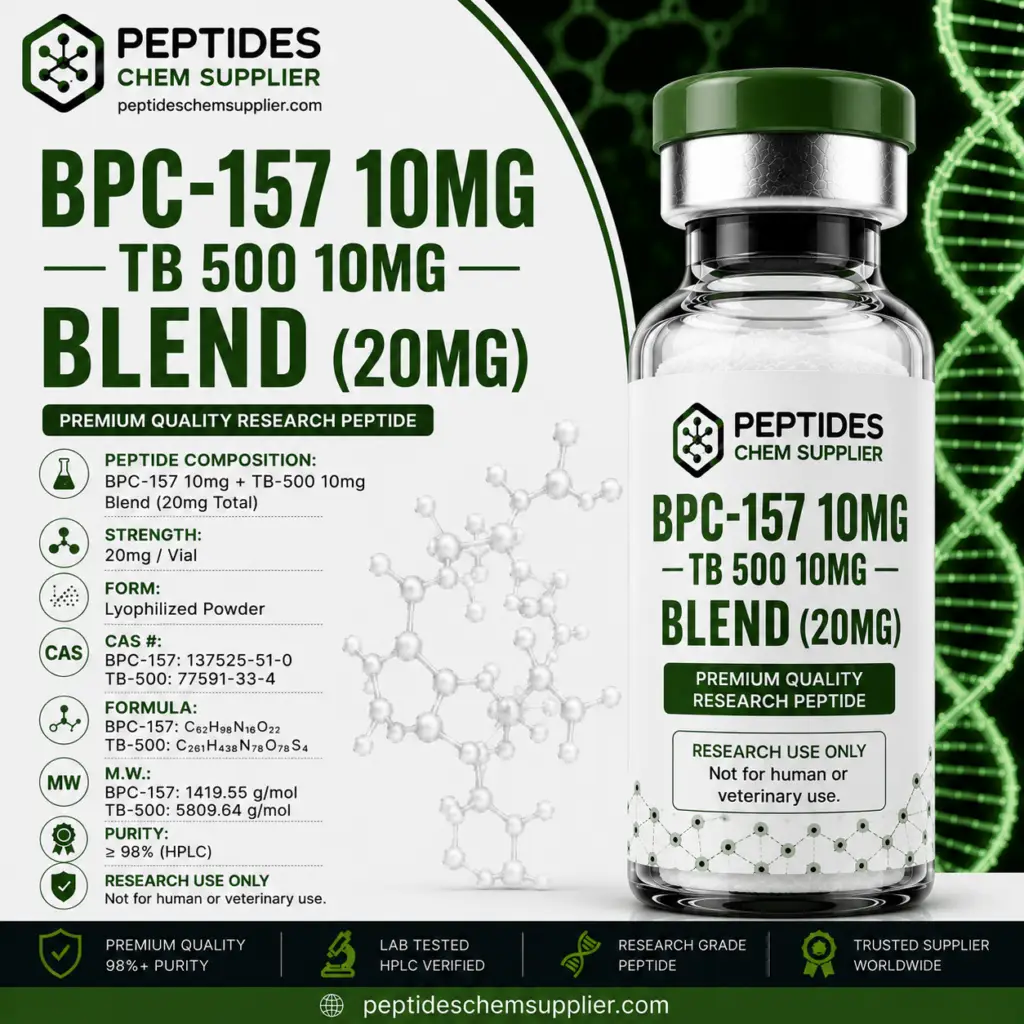
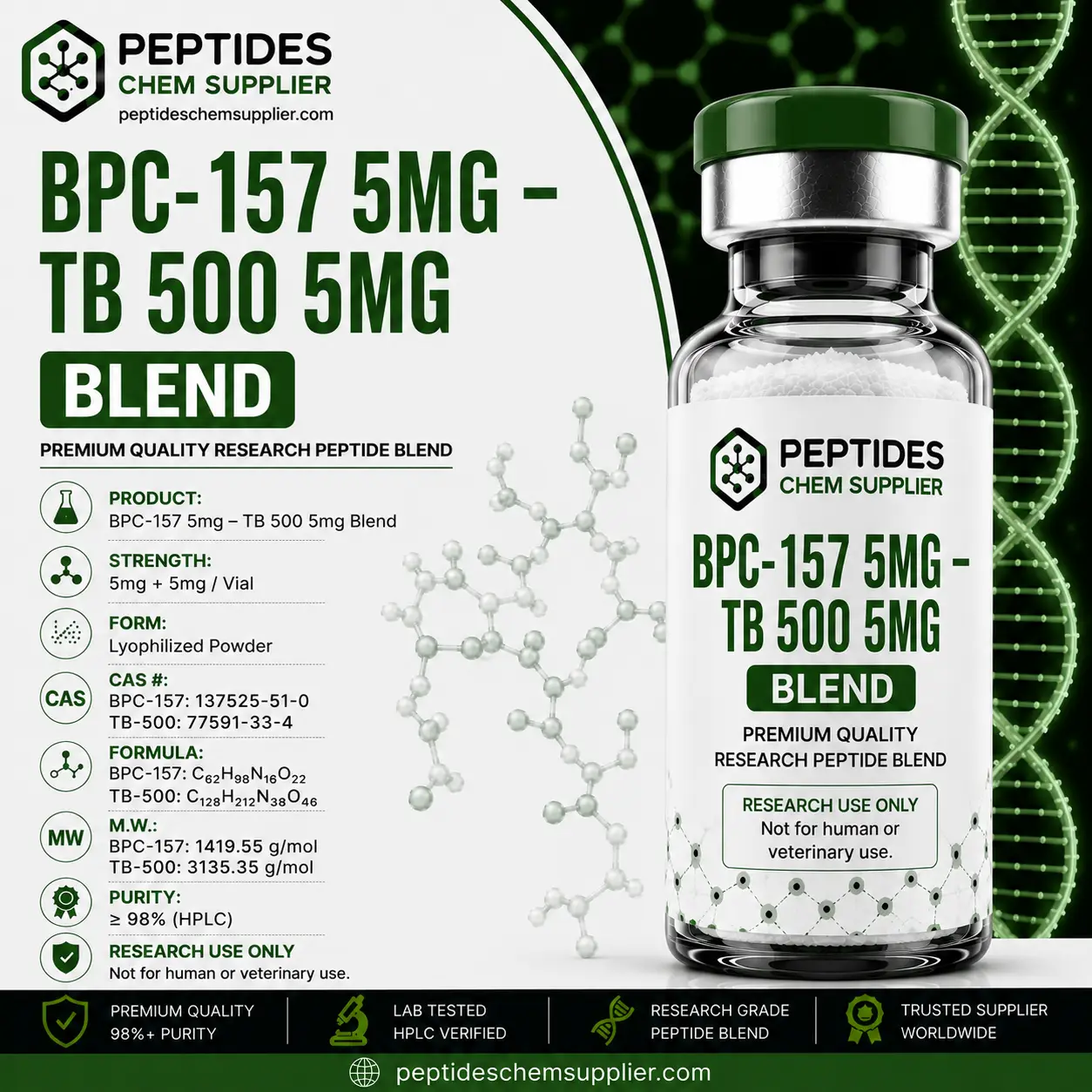
BPC-157 5mg – TB-500 5mg Blend 10mg Research Peptide
Product Name: BPC-157 5mg – TB-500 5mg Blend
Components: BPC-157 5mg + TB-500 5mg
Total Quantity: 10mg
Product Category: Research peptide blend
Research Areas: Peptide biology, cellular signaling, tissue research, and molecular research
Intended Application: Laboratory and analytical research
Format: Refer to current product specifications
Documentation: Batch-specific documentation where available
Purity: Refer to the applicable Certificate of Analysis
Storage: Follow product-specific documentation
Use: Research use only
$55.00
BPC-157 5mg – TB-500 5mg Blend 10mg Research Peptide
BPC-157 5mg – TB-500 5mg Blend is a research-oriented combination containing two distinct synthetic peptide materials: BPC-157 and TB-500. The product contains 5mg of BPC-157 and 5mg of TB-500, providing a total labeled quantity of 10mg.
BPC-157 and TB-500 have different molecular identities and separate research histories. BPC-157 is a 15-amino-acid peptide investigated primarily in preclinical research involving tissue biology, cellular signaling, vascular pathways, gastrointestinal models, and musculoskeletal systems. TB-500 is associated with research into thymosin-beta-4-related biology, including cellular migration, actin-related processes, angiogenesis, and tissue remodeling.
The two peptides remain chemically distinct within the blend. Research involving one component should not automatically be interpreted as evidence for the combination. In particular, combination-specific evidence remains limited, and claims of proven synergy should be avoided.
The product is presented strictly as a research material for qualified laboratory, analytical, educational, and scientific applications.
For Research Use Only. Not for Human Consumption.
BPC-157 5mg – TB-500 5mg Blend Product Information
Product Name: BPC-157 5mg – TB-500 5mg Blend
Components: BPC-157 5mg + TB-500 5mg
Total Quantity: 10mg
Product Category: Research peptide blend
Research Areas: Peptide biology, cellular signaling, tissue research, and molecular research
Intended Application: Laboratory and analytical research
Format: Refer to current product specifications
Documentation: Batch-specific documentation where available
Purity: Refer to the applicable Certificate of Analysis
Storage: Follow product-specific documentation
Use: Research use only
Researchers should verify the current product specifications and batch documentation before incorporating the material into a laboratory workflow.
What Is BPC-157?
BPC-157 is a synthetic 15-amino-acid peptide that has been investigated predominantly in preclinical research.
Research involving BPC-157 has examined experimental models related to:
- Tissue biology
- Cellular signaling
- Vascular pathways
- Gastrointestinal research
- Musculoskeletal research
- Tendon and ligament models
- Angiogenic pathways
- Peptide chemistry
- Molecular interactions
Much of the available BPC-157 literature is based on cell and animal research. Results from these models should therefore be evaluated according to the specific experimental conditions rather than interpreted as established human therapeutic effects.
What Is TB-500?
TB-500 is a synthetic peptide associated with research into thymosin beta-4-related biology. TB-500 should be distinguished from the full-length thymosin beta-4 protein because they are not identical molecular entities.
Research associated with TB-500 and thymosin-beta-4-related pathways includes:
- Cell migration
- Actin-related biology
- Angiogenesis
- Tissue remodeling
- Cellular signaling
- Wound-related research
- Peptide chemistry
- Molecular biology
Researchers should verify the precise identity and specifications of the TB-500 material being evaluated.
BPC-157 and TB-500 Blend Research
BPC-157 and TB-500 are two separate research peptides with different molecular structures and research histories.
The rationale for studying them together generally comes from their overlapping research themes. BPC-157 has been investigated in experimental tissue, vascular, gastrointestinal, and musculoskeletal models, while TB-500-related research has focused on cellular migration, cytoskeletal processes, and tissue remodeling.
However, the existence of research on both individual compounds does not establish that combining them produces a superior or synergistic effect.
Current research reviews emphasize that the evidence for the exact BPC-157 + TB-500 combination is considerably more limited than the individual compound literature.
BPC-157 5mg – TB-500 5mg Research Applications
Peptide Biology
The blend provides a research material containing two separate peptide components that can be evaluated individually and collectively from an analytical perspective.
Cellular Research
Researchers may investigate cellular responses associated with each component using appropriate in-vitro or preclinical research models.
Tissue Biology
Both BPC-157 and TB-500-related research have been associated with experimental tissue and repair models. Researchers should distinguish individual-compound findings from combination-specific evidence.
Vascular Research
BPC-157 research has examined vascular and angiogenic pathways, while thymosin-beta-4-related research has also investigated angiogenesis and cellular responses.
Cell Migration Research
TB-500-related research is particularly relevant to studies of cell migration and cytoskeletal organization.
Analytical Research
Qualified laboratories may characterize the blend for:
- BPC-157 identity
- TB-500 identity
- Individual peptide purity
- Total quantity
- Batch consistency
- Stability
- Peptide-related impurities
- Analytical profile
BPC-157 and TB-500 Are Separate Compounds
The product should not be described as a new single peptide.
The formulation contains:
BPC-157 — 5mg
TB-500 — 5mg
Total labeled quantity — 10mg
The individual components retain their own chemical identities and should be independently characterized where appropriate.
A 1:1 mass ratio does not mean that the two components have the same molecular structure or molecular quantity. Researchers should use analytical documentation to establish the characteristics of the specific material.
Research Evidence for the Combination
The research evidence for BPC-157 and TB-500 individually is substantially greater than the evidence for a standardized commercial blend.
Current literature reviews emphasize several important limitations:
- Most evidence remains preclinical.
- The individual peptides have different research histories.
- TB-500 should not automatically be treated as identical to full-length thymosin beta-4.
- Combination-specific evidence is limited.
- Human evidence for the exact finished blend is insufficient to establish safety or efficacy.
- Proposed synergy should be treated as a research hypothesis rather than an established finding. (PeptideStacks)
This distinction is important for maintaining scientifically accurate product information.
BPC-157 5mg – TB-500 5mg Research Material
The 10mg blend may be evaluated for its physical, chemical, and analytical characteristics.
Laboratory evaluation may include:
- Compound identity
- Individual peptide identity
- Chemical purity
- Molecular characterization
- Concentration
- Stability
- Batch consistency
- Analytical profile
- Impurity assessment
- Structure-function research
Researchers should refer to the applicable product documentation for specific storage and handling requirements.
Certificate of Analysis
A Certificate of Analysis (COA) can provide important batch-specific information when evaluating the BPC-157 and TB-500 blend.
Depending on the applicable batch, documentation may include:
- Product identification
- BPC-157 identification
- TB-500 identification
- Batch or lot number
- Analytical testing
- Reported purity
- Quantity information
- Testing date
- Applicable specifications
- Laboratory test results
Researchers should review the documentation associated with the exact batch being evaluated.
Research Peptide Quality Considerations
When evaluating BPC-157 5mg – TB-500 5mg Blend, laboratories may consider:
- Identity of both peptide components
- Individual quantities
- Peptide sequence
- Batch traceability
- Analytical documentation
- Reported purity
- Physical form
- Stability
- Packaging
- Storage requirements
- Testing information
- Applicable regulatory requirements
Particular attention should be given to the exact identity of TB-500 because terminology surrounding thymosin-beta-4-related peptides can vary between research sources.
BPC-157 TB-500 Research Peptide Supplier
Researchers searching for this material may use several related terms, including:
- BPC-157 5mg TB-500 5mg blend
- BPC-157 TB-500 blend 10mg
- BPC-157 TB-500 research peptide
- BPC-157 research peptide blend
- TB-500 research peptide blend
- BPC-157 and TB-500 research material
- BPC-157 TB-500 laboratory research compound
- BPC-157 TB-500 research material
- BPC-157 TB-500 peptide blend
Using both individual peptide names and the complete product designation can help researchers identify the specific 10mg blend rather than an individual peptide.
International BPC-157 TB-500 Research
Researchers in different geographic markets may use location-specific search terms when looking for BPC-157 and TB-500 research materials.
Relevant searches can include:
- BPC-157 5mg TB-500 5mg blend research USA
- BPC-157 TB-500 research peptide USA
- BPC-157 TB-500 research compound USA
- BPC-157 5mg TB-500 5mg blend research UK
- BPC-157 TB-500 research peptide UK
- BPC-157 TB-500 research compound UK
- BPC-157 5mg TB-500 5mg blend research Canada
- BPC-157 TB-500 research peptide Canada
- BPC-157 TB-500 research compound Canada
- BPC-157 5mg TB-500 5mg blend research Europe
- BPC-157 TB-500 research peptide Europe
- BPC-157 TB-500 research compound Europe
- BPC-157 5mg TB-500 5mg blend research Australia
- BPC-157 TB-500 research peptide Australia
- BPC-157 TB-500 research compound Australia
- BPC-157 5mg TB-500 5mg blend research India
- BPC-157 TB-500 research peptide India
- BPC-157 TB-500 research compound India
Availability, import requirements, customs rules, and regulatory requirements can differ between jurisdictions. Customers and laboratories are responsible for determining the requirements applicable to research materials in their location.
Geographic terminology is included to help researchers locate relevant research information and does not imply authorization for human use in any particular country.
BPC-157 and TB-500 Scientific Research
BPC-157 has been investigated extensively in preclinical research involving tissue, vascular, gastrointestinal, and musculoskeletal models.
TB-500-related research has focused on cellular migration, cytoskeletal processes, angiogenesis, and tissue remodeling. Researchers should distinguish research involving the TB-500 fragment from research involving full-length thymosin beta-4.
For the exact BPC-157/TB-500 combination, the available evidence remains limited. Scientific reviews emphasize that findings from individual compounds cannot automatically establish the safety, efficacy, pharmacology, or synergy of a particular commercial blend.
Frequently Asked Questions About BPC-157 5mg – TB-500 5mg Blend
What is BPC-157 5mg – TB-500 5mg Blend?
It is a research-oriented combination containing 5mg of BPC-157 and 5mg of TB-500, for a total labeled quantity of 10mg.
Are BPC-157 and TB-500 the same peptide?
No. They are two different peptide materials with different molecular structures and research histories.
What is BPC-157 researched for?
BPC-157 has been investigated primarily in preclinical research involving tissue biology, vascular pathways, gastrointestinal models, cellular signaling, and musculoskeletal research.
What is TB-500 researched for?
TB-500-related research has examined cellular migration, actin-related processes, angiogenesis, tissue remodeling, and thymosin-beta-4-associated biological pathways.
Is there proven synergy between BPC-157 and TB-500?
No. A proposed complementary or synergistic relationship remains a research hypothesis and should not be presented as an established therapeutic effect.
Is the BPC-157 TB-500 blend intended for human use?
No. The material is presented strictly as research material and is not intended for human consumption, self-administration, or therapeutic use.
Does the BPC-157 TB-500 blend have a COA?
Batch-specific analytical documentation may be available. Researchers should review the COA associated with the specific batch being evaluated.
How should the BPC-157 TB-500 blend be stored?
Storage and handling should follow the product-specific documentation supplied with the research material and the procedures established by the relevant laboratory.
Research Use Disclaimer
BPC-157 5mg – TB-500 5mg Blend is supplied strictly for research, analytical, educational, and laboratory purposes.
It is not intended for human consumption, self-administration, medical use, therapeutic use, diagnostic use, veterinary use, or use as a food additive.
The information presented on this page is provided for scientific and educational purposes and should not be interpreted as medical advice or as a claim that BPC-157, TB-500, or their combination can diagnose, treat, cure, or prevent any disease or medical condition.
Researchers, institutions, and purchasers are responsible for complying with applicable laws, regulations, import requirements, institutional policies, and laboratory safety requirements governing research materials in their jurisdiction.
Product specifications, analytical information, availability, and documentation may vary by batch. Researchers should refer to the applicable product documentation and Certificate of Analysis for the specific material being evaluated.