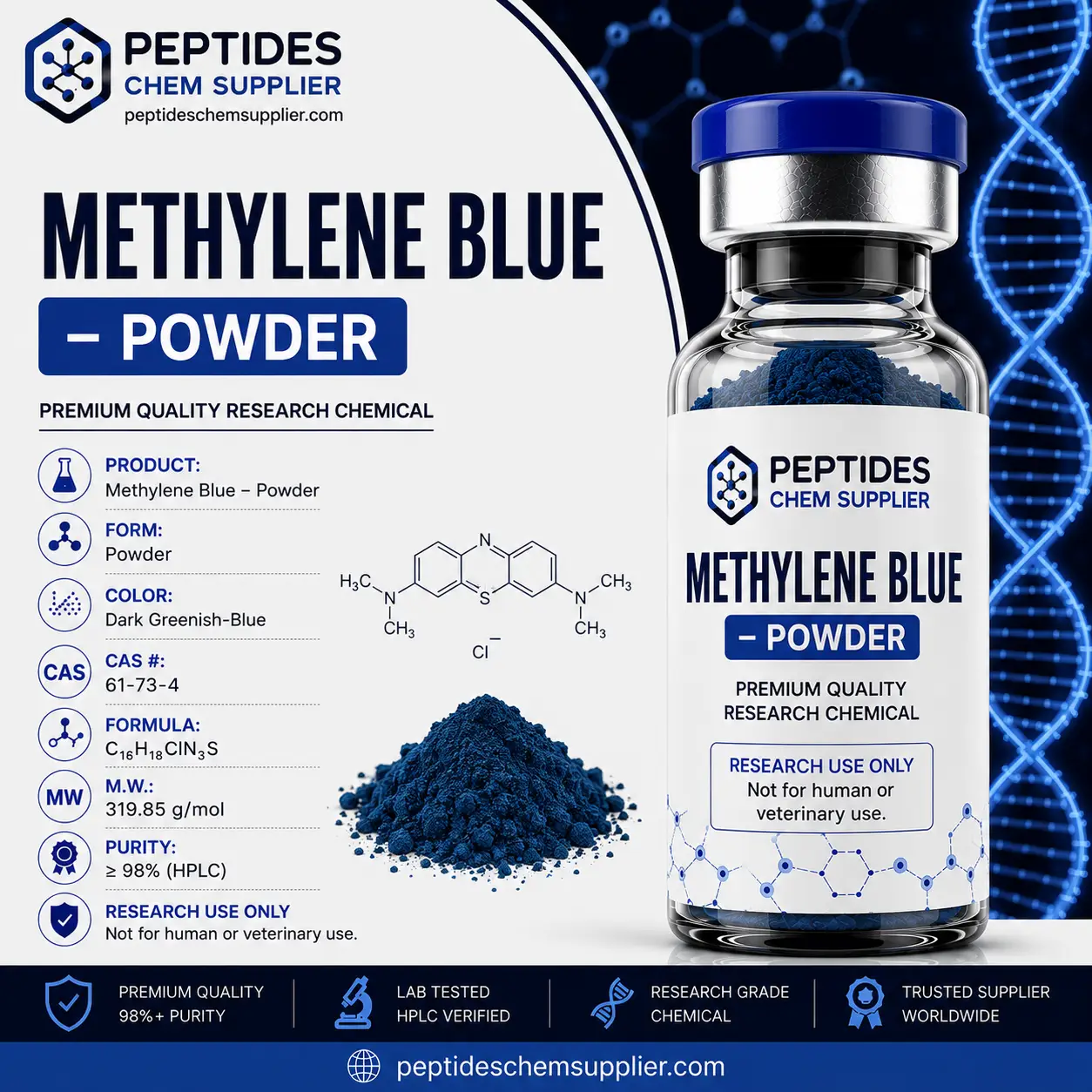
Methylene Blue – Powder
Product Name: Methylene Blue Powder
Chemical Name: Methylthioninium chloride
Common Names: Methylene blue, methylthionine chloride, methylthioninium chloride
Product Type: Research chemical
Physical Form: Powder
Research Areas: Analytical chemistry, microscopy, redox research, microbiology, and cellular research
Intended Application: Laboratory and analytical research
Documentation: Batch-specific documentation where available
Purity: Refer to the applicable Certificate of Analysis
Storage: Follow product-specific documentation
Use: Research use only
$60.00
Methylene Blue Powder Research Compound
Methylene Blue Powder is a research-oriented chemical compound used in laboratory, analytical, educational, and scientific research. Methylene blue, also known as methylthioninium chloride, is a heterocyclic aromatic compound with a long history of use as a laboratory stain and analytical reagent.
Its distinctive chemical and optical properties have made methylene blue relevant to research involving microscopy, cellular biology, redox chemistry, analytical chemistry, microbiology, photochemistry, and molecular research.
Methylene Blue Powder is supplied strictly as a research material for qualified laboratory applications. Researchers should verify the specific grade, purity, batch information, and analytical documentation before use.
For Research Use Only. Not for Human Consumption.
Methylene Blue Powder Product Information
Product Name: Methylene Blue Powder
Chemical Name: Methylthioninium chloride
Common Names: Methylene blue, methylthionine chloride, methylthioninium chloride
Product Type: Research chemical
Physical Form: Powder
Research Areas: Analytical chemistry, microscopy, redox research, microbiology, and cellular research
Intended Application: Laboratory and analytical research
Documentation: Batch-specific documentation where available
Purity: Refer to the applicable Certificate of Analysis
Storage: Follow product-specific documentation
Use: Research use only
Researchers should consult the applicable product documentation for exact specifications, purity, storage, and handling requirements.
What Is Methylene Blue?
Methylene blue is a synthetic organic compound belonging to the phenothiazine family. It is recognized for its intense blue coloration and its ability to participate in reversible oxidation-reduction reactions.
The compound exists in different chemical states depending on its oxidation environment. The oxidized form is strongly colored, while its reduced form, commonly referred to as leucomethylene blue, is much less intensely colored.
This reversible redox behavior makes methylene blue particularly useful for laboratory experiments involving electron transfer, oxidation-reduction chemistry, and indicator systems.
Methylene Blue and Laboratory Research
Methylene blue has been used as a laboratory reagent across numerous scientific disciplines.
Research applications may include:
- Microscopy
- Histological staining
- Microbiology
- Cellular biology
- Redox chemistry
- Analytical chemistry
- Photochemistry
- Oxidation-reduction studies
- Molecular biology
- Chemical indicator research
Its strong visible coloration also makes it useful in experiments where researchers need to observe staining or changes in chemical state.
Methylene Blue in Microscopy Research
One of the best-known laboratory applications of methylene blue is its use as a biological stain.
Researchers can use staining techniques to increase contrast between cellular structures and surrounding material. This can make certain structures easier to observe using optical microscopy.
Methylene blue has been used in various microscopy and educational laboratory settings to investigate:
- Cellular morphology
- Bacterial structures
- Tissue samples
- Cell components
- Microorganism morphology
- Staining behavior
The exact staining method depends on the sample type and experimental objective.
Methylene Blue and Redox Research
Methylene blue is particularly relevant to redox chemistry because it can undergo reversible changes between oxidized and reduced states.
This property allows researchers to investigate:
- Electron-transfer reactions
- Oxidation-reduction mechanisms
- Redox indicators
- Chemical kinetics
- Reducing-agent activity
- Oxidizing-agent activity
- Cellular redox systems
The visible color transition associated with its redox state can also provide a useful qualitative indicator in laboratory experiments.
Methylene Blue in Microbiology Research
Methylene blue has a long history as a staining reagent in microbiological research.
Researchers may investigate microbial morphology and cellular structures through staining procedures designed for microscopic observation.
Potential laboratory applications include:
- Microbial staining
- Cell morphology
- Bacterial visualization
- Microscopy research
- Staining-method comparisons
- Laboratory teaching and analytical studies
Specific protocols should be selected according to the organism, sample, microscopy method, and research objective.
Methylene Blue and Cellular Research
Methylene blue has also been investigated in cellular and biochemical research because of its ability to participate in redox processes and interact with biological systems.
Researchers may investigate its behavior in experimental cellular models, including studies of:
- Cellular redox processes
- Oxidative mechanisms
- Mitochondrial research
- Electron-transfer pathways
- Cellular metabolism
- Molecular interactions
Results obtained from experimental systems should be interpreted according to the specific laboratory model and conditions.
Methylene Blue Powder Research Applications
Analytical Chemistry
Methylene blue can be used as an analytical reagent or indicator in controlled laboratory experiments.
Microscopy
Its staining properties make it useful for increasing contrast in certain biological samples.
Redox Chemistry
Researchers can investigate reversible oxidation-reduction behavior and electron-transfer reactions.
Microbiology
Methylene blue can be used in experimental staining procedures for examining microorganisms and cellular morphology.
Photochemistry
Because methylene blue has distinctive optical absorption characteristics, it can also be studied in photochemical and light-dependent chemical systems.
Chemical Research
Laboratories may evaluate methylene blue’s purity, stability, solubility, spectral characteristics, and chemical behavior.
Methylene Blue Powder Quality Considerations
When evaluating Methylene Blue Powder for research, laboratories may consider:
- Chemical identity
- Purity
- Molecular characteristics
- Physical appearance
- Solubility
- Batch traceability
- Analytical documentation
- Stability
- Packaging
- Storage requirements
- Applicable laboratory standards
Researchers should verify the exact chemical form and grade before beginning an experiment.
Certificate of Analysis
A Certificate of Analysis (COA) can provide important batch-specific information when evaluating Methylene Blue Powder.
Depending on the applicable batch, documentation may include:
- Compound identification
- Batch or lot number
- Purity
- Analytical testing
- Testing date
- Physical or chemical specifications
- Laboratory test results
Researchers should review the COA associated with the specific batch being evaluated rather than relying exclusively on general product descriptions.
Methylene Blue Research Chemical Supplier
Researchers searching for Methylene Blue Powder may use several related terms, including:
- Methylene Blue Powder
- Methylene Blue research compound
- Methylene Blue research chemical
- Methylthioninium chloride research compound
- Methylthionine chloride research material
- Methylene Blue laboratory reagent
- Methylene Blue analytical reagent
- Methylene Blue research material
- Methylene Blue laboratory compound
Using both the common name and chemical name can help researchers locate the correct material and distinguish it from similarly named compounds.
International Methylene Blue Research
Researchers in different geographic markets may use location-specific search terminology when looking for Methylene Blue research materials.
Relevant searches can include:
- Methylene Blue Powder research chemical USA
- Methylene Blue research compound USA
- Methylene Blue research material USA
- Methylene Blue Powder research chemical UK
- Methylene Blue research compound UK
- Methylene Blue research material UK
- Methylene Blue Powder research chemical Canada
- Methylene Blue research compound Canada
- Methylene Blue research material Canada
- Methylene Blue Powder research chemical Europe
- Methylene Blue research compound Europe
- Methylene Blue research material Europe
- Methylene Blue Powder research chemical Australia
- Methylene Blue research compound Australia
- Methylene Blue research material Australia
- Methylene Blue Powder research chemical India
- Methylene Blue research compound India
- Methylene Blue research material India
Availability, import requirements, customs rules, and regulatory requirements can differ between jurisdictions. Customers and laboratories are responsible for determining the requirements applicable to research chemicals in their location.
Geographic terminology is included to help researchers locate relevant research information and does not imply authorization for human use in any particular country.
Methylene Blue and Scientific Research
Methylene blue remains a widely recognized laboratory compound because of its combination of staining, optical, and redox properties.
Its applications extend from basic microscopy and microbiology to analytical chemistry and experimental redox research. Researchers can use controlled laboratory systems to investigate how methylene blue behaves under different chemical, biological, and environmental conditions.
The appropriate grade and analytical specifications should be selected according to the intended research application.
Frequently Asked Questions About Methylene Blue Powder
What is Methylene Blue Powder?
Methylene Blue Powder is a powdered research chemical containing methylene blue, also known as methylthioninium chloride, for qualified laboratory and analytical research.
What is methylene blue used for in research?
Research applications include microscopy, biological staining, microbiology, analytical chemistry, redox research, photochemistry, and cellular studies.
Is methylene blue a peptide?
No. Methylene blue is a small organic chemical compound, not a peptide.
What is the chemical name of methylene blue?
Methylene blue is commonly identified chemically as methylthioninium chloride.
Why is methylene blue useful in redox research?
Methylene blue can reversibly transition between oxidized and reduced chemical states, making it useful for studying electron-transfer and oxidation-reduction processes.
Is Methylene Blue Powder intended for human use?
No. The material is presented strictly as research material and is not intended for human consumption, self-administration, or therapeutic use.
Does Methylene Blue Powder have a COA?
Batch-specific analytical documentation may be available. Researchers should review the Certificate of Analysis associated with the specific batch being evaluated.
How should Methylene Blue Powder be stored?
Storage and handling should follow the product-specific documentation supplied with the research material and the procedures established by the relevant laboratory.
Research Use Disclaimer
Methylene Blue Powder is supplied strictly for research, analytical, educational, and laboratory purposes.
It is not intended for human consumption, self-administration, medical use, therapeutic use, diagnostic use, veterinary use, or use as a food additive.
The information presented on this page is provided for scientific and educational purposes and should not be interpreted as medical advice or as a claim that methylene blue can diagnose, treat, cure, or prevent any disease or medical condition.
Researchers, institutions, and purchasers are responsible for complying with applicable laws, regulations, import requirements, institutional policies, and laboratory safety requirements governing research chemicals in their jurisdiction.
Product specifications, analytical information, availability, and documentation may vary by batch. Researchers should refer to the applicable product documentation and Certificate of Analysis for the specific material being evaluated.